
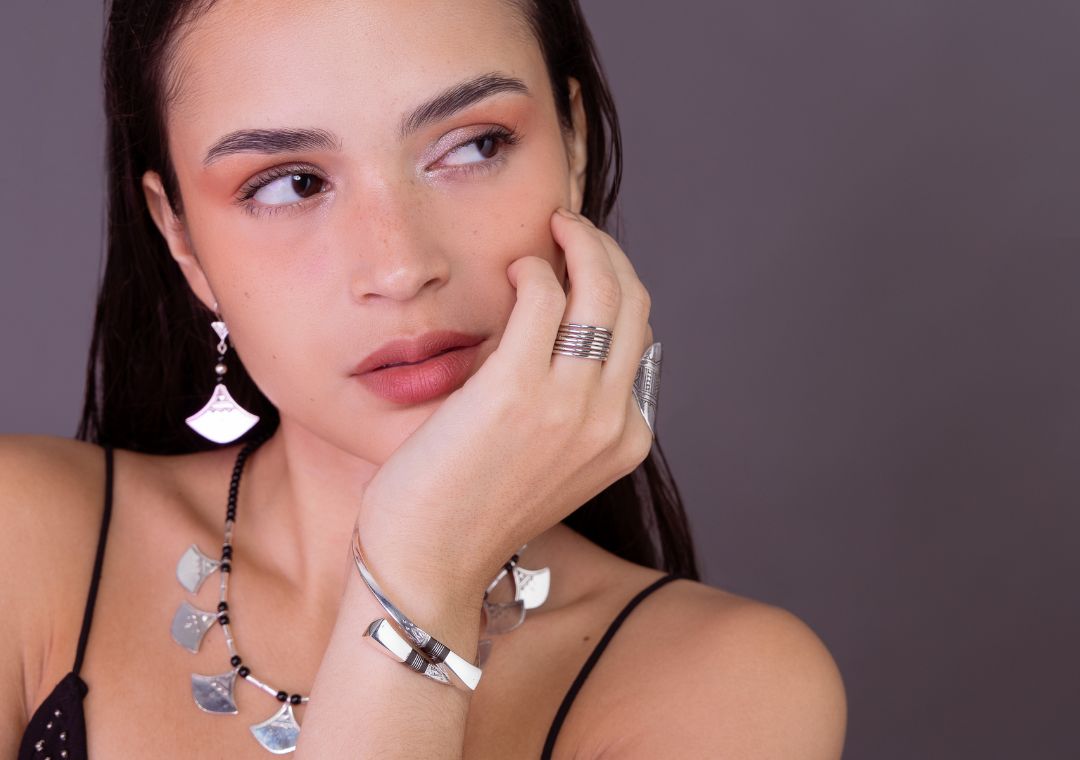
Tuareg jewellery: history and meaning of the Tuareg cross
Tuareg jewellery is recognisable by its geometric shapes, fine engravings and above all the famous Agadez cross. Behind these pieces is a nomadic people of the Sahara and a silversmithing tradition passed down through generations.
Who are the Tuareg?
The Tuareg are a Berber people of the Sahara and the Sahel. They live mainly in Niger, Mali, Algeria, Libya and Burkina Faso. Their language, Tamasheq, is traditionally written in the Tifinagh script, whose signs often appear on the jewellery.
They are sometimes called the “blue men” because of the long indigo veil the men wear to protect themselves from sun and sand. Women traditionally hold a strong position in Tuareg society: they take part in decisions and pass on a large share of the family's property.
The nomadic way of life has declined sharply, but the craft lives on. In Niger, families of smiths, the Inadan, still work silver, copper and ebony using old techniques.
The Tuareg cross and its names
The cross is the best-known piece of jewellery in Tuareg culture. There are dozens of variants, usually named after a town, an oasis or a region: Agadez, Iferouane, In-Gall, Timia, Tahoua, Zinder, Bilma, Aïr, Abalak and many more. In the past, the shape of the cross showed where its wearer came from.

The Agadez cross, named after the large city in northern Niger, is the best known today. It is worn as a pendant, as on this silver necklace with Agadez cross, handmade in Niger, or as earrings such as the Talisman Agadez and Talisman Timia models.
What does the cross mean?
There is no single interpretation. According to a widespread reading, the four arms stand for the four points of the compass, vital for finding your way in the desert. Others see a star or a constellation of the Saharan sky in it.
A legend tells of a father giving his son the cross when he sets off alone into the desert for the first time, saying: “I leave you neither gold nor silver, but the four directions, so that you never lose your way.” The cross thus became a good-luck charm for travelling and a symbol of protection.

Materials and making
Traditional Tuareg jewellery is made of silver, often combined with ebony, leather or beads. The silver is melted, shaped and then engraved by hand. The geometric patterns and small irregularities are the signature of handwork.
At KOOMPLIMENTS, a large part of our Tuareg jewellery comes from Mohamed's workshop in Niger. He learned the craft from his father and today works silver, recycled silver and ebony with his family. We also carry Tuareg-style jewellery made elsewhere, some of it in zamak. Material and origin are always stated on the product page.
How to recognise handmade Tuareg jewellery
- The engravings are not perfectly regular, because they are made by hand, stroke by stroke.
- The patina settles in the recesses and brings out the pattern. That is normal for silver.
- The origin is named: a serious seller tells you where and by whom a piece was made.
You will find rings, earrings, necklaces and bracelets in our collection Tuareg jewellery handmade in Niger, for example the Maradi earrings in recycled silver.